Training BJJ in Iceland: Eight years of camps at Mjölnir
For eight summers, from 2018 to 2025, we took a camp to Reykjavík every year. It ended in July 2025, and since a lot of people still ask about it, here is what training in Iceland with us was like.
I have been going to Iceland for about 20 years. The training there has always been good for a country of fewer than 400,000 people, and the place itself is hard to describe without sounding like a tourist brochure. So I will mostly stick to the mats.
Mjölnir
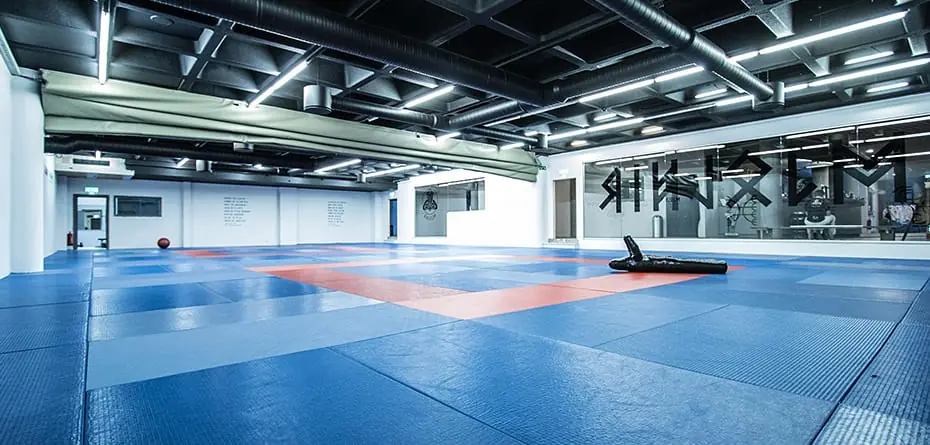
All eight camps were held at Mjölnir, which calls itself the largest grappling and MMA gym in the world. When we were there it had around 3,000 m² of floor space: six matted rooms for Jiu Jitsu and yoga, a full-size cage and a boxing ring, a weight room, and locker rooms with their own sauna and ice bath. Gunnar Nelson trained there, Conor McGregor came through on his way up, and so have most of Iceland’s grappling champions.
For a camp that is an unusual luxury. We could run classes in three rooms at the same time from morning to evening, with open mats in between, and still not fill the building. The camp usually started on a Monday around noon and ran until a long open mat on Saturday afternoon. Training went from about 9 in the morning to 8 at night, roughly half gi and half no-gi, taught by instructors who brought in their own background from wrestling, judo and luta livre as well as BJJ.
The locals were a big part of it. Mjölnir members dropped in for classes and open mats all week, so you got to roll with Icelanders and not just with the other campers. A few of them later taught at our other camps.
Vikings vs. Tourists
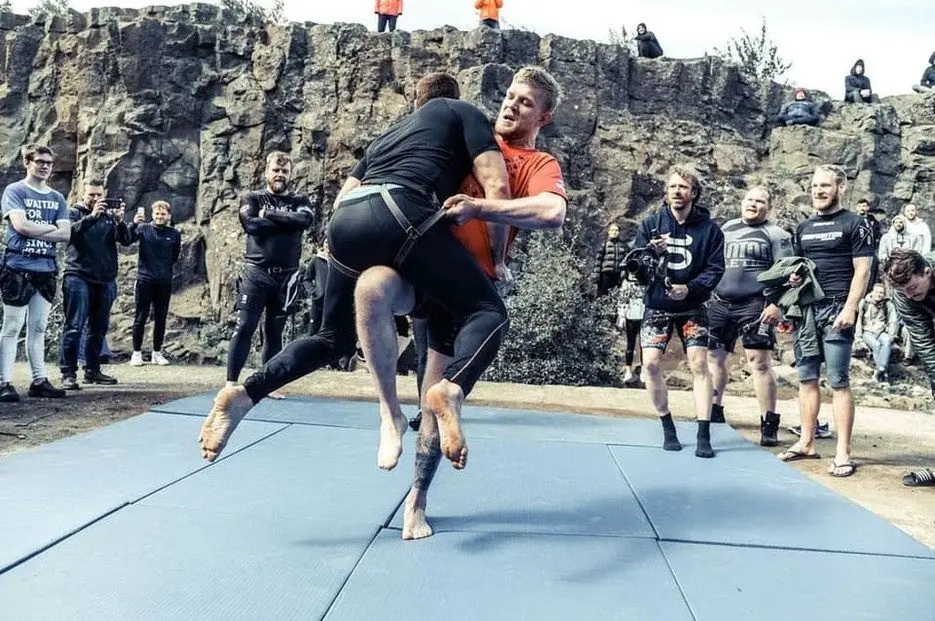
The thing most people remember from the Iceland camps is glíma. It is the old Icelandic folk wrestling style, with a written history going back to at least 1325. You take hold of your opponent’s belt and try to take them off their feet. It looks simple from the outside and it is not.
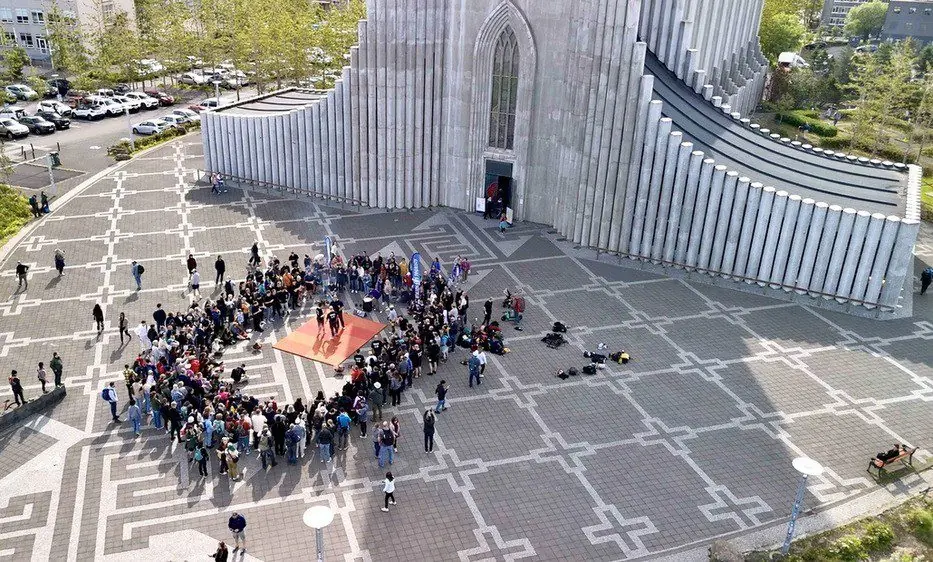
It started as a bit of a joke. We asked the local glíma people if they would wrestle our campers, and it became a fixed part of every camp: Vikings vs. Tourists, held outdoors with mats rolled out on the grass or the rocks. The Vikings won every year. The tourists got silver medals, which looked very good on Instagram. Glíma is struggling to stay alive in Iceland, and I like to think a few hundred foreigners getting thrown around once a year helped a little.
Off the mats
Reykjavík is small enough to walk around and big enough that you do not run out of things to do in a week: concert halls, old wooden houses, cafés that turn into bars late at night, whale watching, the Northern Lights if you come at the right time of year, and a phallological museum if you are curious. About half the country lives in or near the city.
On one day of the camp we hired buses and took everyone around the Golden Circle: Þingvellir National Park, the Geysir area and the Gullfoss waterfall and the greenhouses at Friðheimar. We left in the morning and were back at Mjölnir in time for the afternoon classes. Plenty of people also went to the hot springs or the Blue Lagoon, or got in the North Atlantic, which is cold in July too. The last night was a barbecue and a party.
2020
The 2020 camp deserves its own line. It was one of the very few camps anywhere that year. A short-notice ban on travellers from the US meant that around 50 Americans could not come, so the camp ended up at about half the expected size. A lot of locals came instead, and for a week we more or less forgot about the pandemic. Rolling hurt quite a bit after a year with very little training.
The last one
In 2025 we decided it would be the last Iceland Camp. We were running 14 camps a year, and I needed to find some way of doing fewer of them. I will never say never, because I like going to Iceland too much, but for now the camp is over.
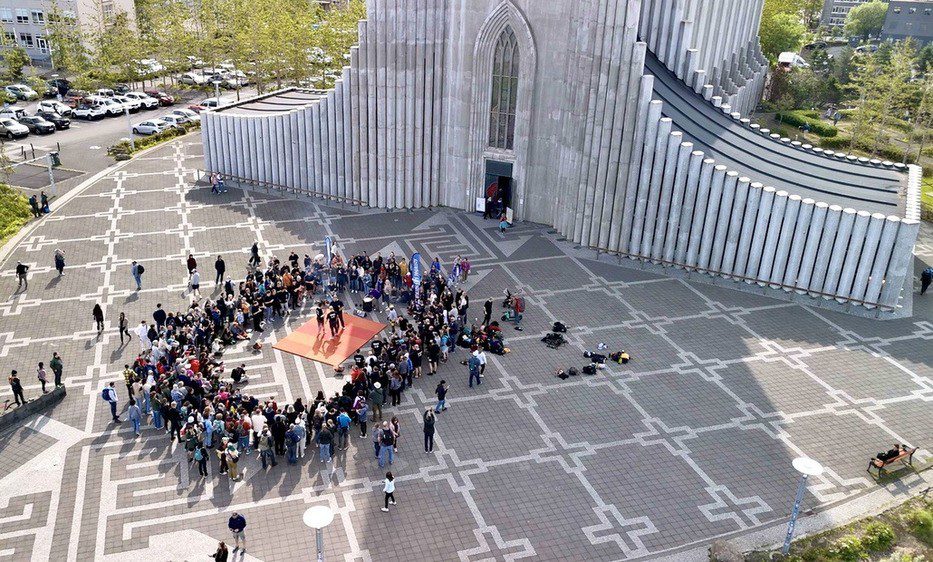
Since it was the last one, we spent most of the year getting a permit to hold Vikings vs. Tourists in the centre of Reykjavík. It was not easy, but on a sunny day in July around 40 campers wrestled the locals on mats laid out in front of Hallgrímskirkja, with a crowd of tourists who had no idea what was going on. The Vikings won again.
If you want to train in Iceland on your own, Mjölnir takes visitors, and there are affiliated academies around the country, such as Atlantic Jiu-Jitsu and BJJ North. A few more Iceland stories are in Memories of 99 Globetrotters camps, and the camps we still run are on the camps page.
Adapted from our newsletters 2017 to 2025.